Thematic deck
World War II timeline
From Hitler's rise to the Nuremberg trials: the Second World War in 200 cards, on every front.
Play the deck
Five cards from the World War II deck. Earlier events go higher.
The full World War II timeline
The World War II deck comes with Epoch Infinite. Endless, the Daily Challenge and online games are free.
-
30 January 1933 CE
Hitler Is Appointed Chancellor of Germany
On 30 January 1933, Germany's president appointed Adolf Hitler head of government, in a cabinet where conservatives believed they could control him.
Did you know? He had never won a majority in a free election, and within two months emergency powers had ended the republic entirely.
-
15 September 1935 CE
Germany Enacts the Nuremberg Race Laws
On 15 September 1935, the Reichstag passed laws at Nuremberg that stripped German Jews of citizenship and forbade marriage between Jews and other Germans.
Did you know? The laws forced Nazi officials to invent a legal definition of who counted as a Jew, and that definition later decided who was deported.
-
7 July 1937 CE
A Clash at the Marco Polo Bridge Opens the Second Sino-Japanese War
On 7 July 1937, a night-time exchange of fire between Japanese and Chinese troops at the Marco Polo Bridge near Beijing escalated into full-scale war.
Did you know? Many historians treat this skirmish, not the invasion of Poland, as the true opening of the Second World War.
-
13 December 1937 CE
Japanese Forces Enter Nanjing
On 13 December 1937, Japanese troops captured the Chinese capital of Nanjing and began weeks of mass killing and rape that left tens of thousands dead.
Did you know? Foreign residents who stayed behind organised a safety zone in the city that sheltered many thousands of civilians.
-
12 March 1938 CE
Germany Annexes Austria
On 12 March 1938, German forces crossed into Austria unopposed, and the country was annexed to the Reich the following day.
Did you know? Hitler had been born an Austrian, and three days later he addressed a vast crowd on the Heldenplatz in Vienna.
-
30 September 1938 CE
Chamberlain Returns from Munich Promising Peace
On 30 September 1938, Britain's prime minister landed at a London aerodrome waving an agreement with Hitler that handed over part of Czechoslovakia, and outside Downing Street that evening said it meant peace for our time.
Did you know? Britain declared war eleven months later, and the phrase has been shorthand for wishful diplomacy ever since.
-
9 November 1938 CE
Kristallnacht: Nazi Pogroms Sweep Germany and Austria
On 9 November 1938, Nazi pogroms across Germany and Austria burned hundreds of synagogues, smashed Jewish shopfronts and sent tens of thousands of Jewish men to concentration camps.
Did you know? The pogrom is known as Kristallnacht, the 'Night of Broken Glass', after the shattered shop windows; the Nazi state then fined the Jewish community for the damage.
-
2 December 1938 CE
The First Kindertransport Children Reach Britain
On 2 December 1938, a ship carrying about two hundred Jewish children from Germany docked at Harwich, beginning the rescue operation later known as the Kindertransport.
Did you know? Nearly ten thousand children were brought to Britain this way, most of them without their parents, and most never saw them again.
-
15 March 1939 CE
Germany Occupies the Czech Lands
On 15 March 1939, German troops entered Prague and occupied what remained of Czechoslovakia, breaking the agreement signed at Munich six months earlier.
Did you know? It ended any remaining faith in appeasement, and within two weeks Britain had guaranteed Poland's borders.
-
27 May 1939 CE
A Ship of Jewish Refugees Is Turned Away
On 27 May 1939, the liner St. Louis reached Havana carrying more than nine hundred Jewish refugees from Germany, and was refused entry there and then by the United States.
Did you know? The ship sailed back to Europe, where several hundred of its passengers were later murdered in the Holocaust.
-
25 July 1939 CE
Poland Hands Its Enigma Secrets to Britain and France
On 25 July 1939, Polish cryptologists revealed to British and French officers near Warsaw that they had been reading German Enigma traffic, and gave them replica machines.
Did you know? Bletchley Park's whole codebreaking effort began from what three Polish mathematicians handed over five weeks before the war.
-
20 August 1939 CE
Zhukov Crushes the Japanese at Khalkhin Gol
On 20 August 1939, Soviet and Mongolian forces under Georgy Zhukov opened the offensive on the Khalkhin Gol river that destroyed a Japanese army on the Manchurian border.
Did you know? The defeat helped persuade Japan to expand southwards against the European empires rather than north against the Soviet Union.
-
23 August 1939 CE
Germany and the Soviet Union Sign a Pact of Non-Aggression
On 23 August 1939, German and Soviet foreign ministers signed a non-aggression pact in Moscow whose secret protocol divided eastern Europe between them.
Did you know? Two bitter ideological enemies had agreed to carve up their neighbours, and the world learned the secret clauses only after the war.
-
1 September 1939 CE
Germany Invades Poland
On 1 September 1939, Germany invaded Poland, beginning the Second World War in Europe.
Did you know? Britain and France declared war on Germany two days later.
-
3 September 1939 CE
Britain and France Declare War on Germany
On 3 September 1939, after Germany ignored an ultimatum to withdraw from Poland, Britain and then France declared war.
Did you know? Chamberlain told the nation by radio that no such undertaking had been received, and added that it was a bitter blow to him.
-
17 September 1939 CE
The Red Army Invades Poland From the East
On 17 September 1939, Soviet forces crossed into eastern Poland under the secret terms of the pact with Germany, while the Polish army was still fighting in the west.
Did you know? Poland was partitioned for the fourth time in its history, and its government fled into exile that same night.
-
27 September 1939 CE
Warsaw Capitulates After a Month Under Siege
On 27 September 1939, Warsaw surrendered after weeks of bombardment and air attack that killed thousands of civilians and destroyed much of the city.
Did you know? The defenders had held out on horsemeat and rationed water long after the government had left.
-
October 1939 CE
Hitler Authorises the Killing of Disabled Patients
In October 1939, Hitler signed an authorisation, backdated to the first day of the war, for doctors to grant a so-called mercy death to patients judged incurable.
Did you know? The gas chambers and the staff first used to murder disabled Germans were later moved east and used on Jews.
-
30 November 1939 CE
The Soviet Union Attacks Finland
On 30 November 1939, Soviet forces crossed the Finnish border and bombed Helsinki, beginning the Winter War.
Did you know? Finnish ski troops in white camouflage destroyed far larger Soviet columns, and the Red Army's poor showing convinced Hitler it would collapse quickly.
-
17 December 1939 CE
The Admiral Graf Spee Is Scuttled off Montevideo
On 17 December 1939, the German pocket battleship Admiral Graf Spee was scuttled outside Montevideo after being damaged by British cruisers at the River Plate.
Did you know? Crowds lined the shore to watch, and her captain shot himself three days later.
-
8 January 1940 CE
Britain Begins Rationing Food
On 8 January 1940, Britain introduced rationing of bacon, butter and sugar, the first of the controls that would govern British diets for fourteen years.
Did you know? Rationing outlasted the war by nearly a decade, and meat was the last item to come off the books.
-
13 March 1940 CE
Finland Cedes Territory to End the Winter War
On 13 March 1940, the Moscow Peace Treaty ended the Winter War, with Finland surviving as an independent state but giving up a tenth of its territory.
Did you know? Finland had lost far fewer soldiers than the Soviet Union and still lost the war.
-
April 1940 CE
Soviet Police Begin Shooting Polish Officers at Katyn
In April 1940, Soviet security police began executing thousands of captured Polish officers and officials in the Katyn forest and other sites on Stalin's written order.
Did you know? The Soviet Union blamed Germany for the graves for half a century, admitting the truth only in 1990.
-
9 April 1940 CE
Germany Seizes Denmark and Norway in a Day
On 9 April 1940, German forces occupied Denmark within hours and landed at ports the length of Norway, securing iron ore routes and Atlantic bases.
Did you know? Denmark's government surrendered before breakfast; Norway fought on for two months with British and French help.
-
10 May 1940 CE
Germany Attacks the Netherlands, Belgium and Luxembourg
On 10 May 1940, German forces struck west into the Low Countries, drawing the Allied armies north while armoured divisions cut through the Ardennes behind them.
Did you know? Glider troops landed on the roof of Belgium's strongest fort and took it in a morning.
-
10 May 1940 CE
Churchill Takes Office as Prime Minister
On 10 May 1940, Winston Churchill became prime minister of a coalition government on the same day Germany attacked in the west.
Did you know? He told the Commons three days later that he had nothing to offer but blood, toil, tears and sweat.
-
14 May 1940 CE
Bombers Destroy the Centre of Rotterdam
On 14 May 1940, German aircraft burned out the heart of Rotterdam, and the Netherlands surrendered the following day under the threat that other cities would follow.
Did you know? Around twenty-five thousand homes were destroyed, and the flattened centre was rebuilt after the war in a modern style unlike any other Dutch city.
-
26 May 1940 CE
Little Ships Evacuate Dunkirk
On 26 May 1940, Britain began lifting a trapped army off the beaches of northern France, helped by hundreds of civilian pleasure boats and fishing craft.
Did you know? Around 338,000 men were taken off in nine days; the army was saved but left almost all of its equipment behind.
-
28 May 1940 CE
Belgium Surrenders, Exposing the Allied Flank
On 28 May 1940, King Leopold III surrendered the Belgian army, opening a gap on the flank of the British and French forces retreating towards the Channel.
Did you know? The king stayed in occupied Belgium as a prisoner, a decision that cost him his throne after the war.
-
4 June 1940 CE
Churchill Promises to Fight on the Beaches
On 4 June 1940, with the last troops off the Dunkirk sands, Churchill told the House of Commons that Britain would fight on the beaches and would never surrender.
Did you know? He is said to have muttered a far less heroic line to a colleague as he sat down.
-
10 June 1940 CE
Mussolini Declares War From a Balcony in Rome
On 10 June 1940, Mussolini declared war on Britain and France from a balcony in Rome, with the French army already collapsing.
Did you know? Roosevelt called it the stab in the back of a neighbour who was already down.
-
14 June 1940 CE
German Troops March Into Paris
On 14 June 1940, German forces entered Paris, which had been declared an open city and left undefended as its government fled south.
Did you know? Two million Parisians had already gone, and the swastika flew from the Eiffel Tower within days.
-
18 June 1940 CE
De Gaulle Broadcasts an Appeal From London
On 18 June 1940, a little-known French general broadcast from London that the flame of French resistance must not go out, refusing to accept his country's defeat.
Did you know? Almost nobody in France heard the broadcast live, and no recording of it survives.
-
22 June 1940 CE
France Signs an Armistice in a Railway Carriage
On 22 June 1940, France signed an armistice with Germany at Compiegne, in the same railway carriage where Germany had accepted defeat in 1918.
Did you know? Hitler had the carriage brought out of a museum for the ceremony, and later had it destroyed.
-
3 July 1940 CE
The Royal Navy Fires on the French Fleet
On 3 July 1940, British warships opened fire on the French squadron at Mers-el-Kebir in Algeria to stop it falling into German hands, killing nearly 1,300 French sailors.
Did you know? It shocked France and convinced Roosevelt that Britain genuinely intended to fight on.
-
10 July 1940 CE
France's Parliament Votes Full Powers to Petain
On 10 July 1940, the French parliament meeting at Vichy voted to give Marshal Petain authority to rewrite the constitution, ending the Third Republic.
Did you know? The regime that followed collaborated in the deportation of Jews from French soil.
-
10 July 1940 CE
The Battle of Britain Begins
On 10 July 1940, the German air force opened a sustained campaign to destroy the Royal Air Force and clear the way for an invasion of Britain.
Did you know? Radar stations gave defenders a few minutes' warning, and the pilots who flew against them averaged about twenty years old.
-
7 September 1940 CE
The Blitz Begins Over London
On 7 September 1940, around 350 German bombers attacked London in daylight and returned that night, beginning fifty-seven consecutive nights of bombing.
Did you know? Around a million London homes were damaged or destroyed, and families slept on Underground platforms the government had initially tried to keep them out of.
-
15 September 1940 CE
The Battle of Britain Reaches Its Climax
On 15 September 1940, RAF fighters beat back the Luftwaffe's heaviest daylight raids on London at the climax of the Battle of Britain, and the invasion plan was shelved two days later.
Did you know? The date is still marked in Britain each year as Battle of Britain Day.
-
17 September 1940 CE
Hitler Postpones the Invasion of Britain
On 17 September 1940, with air superiority still not won, Hitler postponed Operation Sea Lion indefinitely and the invasion barges were dispersed.
Did you know? It was the first strategic objective Germany had set itself and failed to reach.
-
22 September 1940 CE
Japan Moves Into Northern Indochina
On 22 September 1940, Japanese forces entered northern French Indochina by agreement with the Vichy authorities, gaining bases within reach of southern China.
Did you know? The move triggered the first American export restrictions on Japan, a spiral that ended at Pearl Harbor.
-
27 September 1940 CE
Germany, Italy and Japan Sign the Tripartite Pact
On 27 September 1940, Germany, Italy and Japan signed a pact in Berlin pledging mutual assistance, formally creating the Axis alliance.
Did you know? The clause promising help if one of them was attacked by a power not yet at war was aimed squarely at the United States.
-
28 October 1940 CE
Italy Invades Greece and Is Driven Back
On 28 October 1940, Italian forces attacked Greece from Albania, and within weeks the Greek army had thrown them back across the border.
Did you know? Greeks still mark the anniversary as Oxi Day, after the one-word answer their government gave to Mussolini's ultimatum.
-
11 November 1940 CE
Torpedo Biplanes Cripple the Italian Fleet at Taranto
On the night of 11 November 1940, twenty-one obsolete Swordfish biplanes from a British carrier disabled three Italian battleships in the harbour at Taranto.
Did you know? Japanese officers studied the raid closely before planning the attack on Pearl Harbor.
-
14 November 1940 CE
A Night of Bombing Guts Coventry
On the night of 14 November 1940, some five hundred German bombers destroyed the centre of Coventry and its medieval cathedral, killing over five hundred people.
Did you know? The ruined cathedral was deliberately left standing beside its modern replacement as a memorial.
-
16 November 1940 CE
The Warsaw Ghetto Is Sealed
On 16 November 1940, German authorities closed the Warsaw ghetto, confining more than four hundred thousand Jews behind a wall in about three square kilometres.
Did you know? Hunger and disease killed tens of thousands there before the first deportation train left.
-
9 December 1940 CE
A Small British Force Routs the Italians in Egypt
On 9 December 1940, a British and Commonwealth force of two divisions attacked a far larger Italian army in Egypt and drove it back across Libya.
Did you know? The raid intended to last five days ran for two months and took over a hundred thousand prisoners.
-
12 February 1941 CE
Rommel Lands in Tripoli With the Afrika Korps
On 12 February 1941, Erwin Rommel arrived at Tripoli with the first German troops sent to rescue Italy's collapsing position in North Africa.
Did you know? Within six weeks he had attacked without orders and pushed the British back almost to Egypt.
-
11 March 1941 CE
Roosevelt Signs the Lend-Lease Act
On 11 March 1941, Roosevelt signed the Lend-Lease Act, letting the United States supply weapons and materials to Britain and later the Soviet Union without immediate payment.
Did you know? Roosevelt sold the idea to Americans by comparing it to lending a neighbour your garden hose while his house burned.
-
6 April 1941 CE
Germany Attacks Yugoslavia and Greece
On 6 April 1941, German forces bombed Belgrade and invaded both Yugoslavia and Greece, overrunning the Balkans within a month.
Did you know? The campaign is often said to have delayed the attack on the Soviet Union until the summer was half gone.
-
10 April 1941 CE
The Garrison of Tobruk Is Cut Off
On 10 April 1941, Rommel's advance surrounded the Australian-led garrison of the Libyan port of Tobruk, beginning a siege that lasted eight months.
Did you know? German radio called the defenders rats caught in a trap, and they adopted the name with pride.
-
13 April 1941 CE
Moscow and Tokyo Agree to Stay Out of Each Other's Wars
On 13 April 1941, the Soviet Union and Japan signed a neutrality pact in Moscow that held for the next four years.
Did you know? It let Stalin move Siberian divisions west to save Moscow, and it left Japan free to strike south.
-
9 May 1941 CE
A Sinking U-Boat Yields Its Enigma Secrets
On 9 May 1941, a British boarding party seized cipher machine settings and codebooks from U-110 in the North Atlantic before the submarine sank.
Did you know? The capture was kept secret for thirty years, and the crew of the U-boat never knew their codes had been taken.
-
20 May 1941 CE
German Paratroops Descend on Crete
On 20 May 1941, German airborne forces landed on Crete and took the island from British, Greek and Commonwealth defenders after ten days of fighting.
Did you know? Losses among the paratroops were so heavy that Hitler never again ordered a large airborne assault.
-
24 May 1941 CE
HMS Hood Blows Up in the Denmark Strait
On 24 May 1941, the battlecruiser HMS Hood exploded within minutes of engaging the Bismarck, and only three of her 1,418 crew survived.
Did you know? Hood had been the pride of the Royal Navy for twenty years, and Britain hunted the Bismarck relentlessly afterwards.
-
27 May 1941 CE
The Bismarck Is Hunted Down and Sunk
On 27 May 1941, the German battleship Bismarck was sunk in the Atlantic after a torpedo from an obsolete biplane jammed her steering and left her circling.
Did you know? One of the most powerful warships afloat was doomed by a fabric-covered aircraft with a top speed under 140 miles an hour.
-
22 June 1941 CE
Germany Invades the Soviet Union
On 22 June 1941, more than three million Axis soldiers attacked the Soviet Union along a front stretching from the Baltic to the Black Sea.
Did you know? It was the largest invasion in history, and Stalin had refused to believe the warnings until the shells landed.
-
26 July 1941 CE
Washington Freezes Japanese Assets and Cuts Off Oil
On 26 July 1941, the United States froze Japanese assets, and the embargo that followed cut off around four-fifths of Japan's oil supply.
Did you know? Japan's navy calculated it had about two years of fuel left, which set the clock running towards Pearl Harbor.
-
31 July 1941 CE
Goering Orders Preparations for a 'Final Solution'
On 31 July 1941, Hermann Goering authorised Reinhard Heydrich in writing to prepare a comprehensive plan for what the order called the final solution of the Jewish question.
Did you know? The single-page document became a central exhibit in the Nuremberg trials.
-
14 August 1941 CE
Roosevelt and Churchill Issue the Atlantic Charter
On 14 August 1941, US President Franklin Roosevelt and British Prime Minister Winston Churchill issued the Atlantic Charter, setting out shared goals for the postwar world.
Did you know? Its principles, including self-determination for nations, later helped shape the founding charter of the United Nations.
-
September 1941 CE
Poison Gas Is First Used to Kill at Auschwitz
In September 1941, the SS at Auschwitz killed several hundred Soviet prisoners of war and sick inmates with the pesticide Zyklon B in a cellar of the main camp.
Did you know? The camp staff were testing a method, and within a year it was being used on trainloads of people at a time.
-
8 September 1941 CE
German Forces Close the Ring Around Leningrad
On 8 September 1941, German troops cut the last land route into Leningrad, beginning a siege that lasted almost nine hundred days and killed around a million civilians.
Did you know? In the first winter the ration fell to 125 grams of adulterated bread a day, and supplies came in over the ice of a frozen lake.
-
29 September 1941 CE
Nearly Thirty-Four Thousand Jews Are Shot at Babi Yar
On 29 and 30 September 1941, German units and local auxiliaries shot 33,771 Jews from Kyiv in the ravine of Babi Yar.
Did you know? It was one of the largest single massacres of the Holocaust, and it was carried out by rifle fire over two days.
-
2 October 1941 CE
Germany Opens Its Drive on Moscow
On 2 October 1941, Germany launched Operation Typhoon, the offensive intended to take Moscow before winter, encircling whole Soviet armies as it advanced.
Did you know? German officers claimed to have seen the spires of the Kremlin through field glasses before the attack stalled.
-
5 December 1941 CE
The Red Army Counterattacks Before Moscow
On 5 December 1941, Soviet forces including fresh divisions from Siberia counterattacked outside Moscow and drove the exhausted German armies back.
Did you know? It was the first major defeat the German army had suffered on land, and it ended any hope of a quick war.
-
7 December 1941 CE
Japan Attacks Pearl Harbor
On 7 December 1941, Japanese aircraft attacked the United States naval base at Pearl Harbor in Hawaii.
Did you know? The following day, the United States entered the Second World War.
-
8 December 1941 CE
Congress Declares War on Japan
On 8 December 1941, the United States Congress declared war on Japan after Roosevelt called the previous day a date which will live in infamy.
Did you know? The vote in the House was 388 to 1; the single dissenter was a lifelong pacifist who had also voted against war in 1917.
-
8 December 1941 CE
The First Camp Built for Killing Begins Work at Chelmno
On 8 December 1941, the SS at Chelmno in occupied Poland began murdering Jews in sealed vans using engine exhaust, the first camp created purely to kill.
Did you know? Only a handful of people are known to have survived Chelmno out of at least 150,000 sent there.
-
10 December 1941 CE
Japanese Aircraft Sink Two British Capital Ships at Sea
On 10 December 1941, Japanese torpedo bombers sank the battleship Prince of Wales and the battlecruiser Repulse off Malaya, the first capital ships lost to air attack while under way.
Did you know? Churchill said he never received a more direct shock in the whole war.
-
11 December 1941 CE
Germany and Italy Declare War on the United States
On 11 December 1941, Germany and Italy declared war on the United States, turning two separate conflicts into a single global war.
Did you know? No treaty obliged Hitler to do it, and it remains one of the most argued-over decisions of his career.
-
19 December 1941 CE
Hitler Takes Personal Command of the German Army
On 19 December 1941, after the failure before Moscow, Hitler dismissed his army commander-in-chief and took the post himself.
Did you know? From then on the man directing every major operation had never held a command above corporal in the previous war.
-
25 December 1941 CE
Hong Kong Surrenders on Christmas Day
On 25 December 1941, the British colony of Hong Kong surrendered to Japanese forces after eighteen days of fighting.
Did you know? Survivors called it Black Christmas, and the occupation lasted until the war's final week.
-
1 January 1942 CE
Twenty-Six Nations Pledge to Fight the Axis Together
On 1 January 1942, twenty-six countries signed the Declaration by United Nations in Washington, binding themselves not to make a separate peace.
Did you know? Roosevelt coined the name, and it was still available three years later for the organisation founded at San Francisco.
-
20 January 1942 CE
Officials Meet at Wannsee to Coordinate the Killing of Europe's Jews
On 20 January 1942, fifteen senior German officials met at a villa on the Wannsee in Berlin to coordinate the deportation and murder of the Jews of Europe.
Did you know? The meeting lasted about ninety minutes, and one copy of its minutes survived the war to be read at Nuremberg.
-
15 February 1942 CE
Singapore Surrenders to the Japanese Army
On 15 February 1942, the British garrison of Singapore surrendered, and some eighty thousand troops went into a captivity many did not survive.
Did you know? Churchill called it the worst disaster and largest capitulation in British history.
-
19 February 1942 CE
Roosevelt Orders Japanese Americans Into Camps
On 19 February 1942, Executive Order 9066 authorised the removal of about 120,000 people of Japanese descent, most of them American citizens, to inland camps.
Did you know? The United States formally apologised and paid reparations to survivors in 1988.
-
19 February 1942 CE
Japanese Aircraft Bomb Darwin
On 19 February 1942, Japanese carrier aircraft attacked Darwin in northern Australia, killing more than two hundred people in the heaviest raid ever mounted on the country.
Did you know? More bombs fell on Darwin that morning than on Pearl Harbor.
-
17 March 1942 CE
Operation Reinhard Begins With the Opening of Belzec
On 17 March 1942, the killing centre at Belzec in occupied Poland began operating, opening the campaign that murdered the Jews of the General Government.
Did you know? Fewer than ten people are known to have survived Belzec, where at least 434,000 were killed in nine months.
-
27 March 1942 CE
The First Deportation Train Leaves France for Auschwitz
On 27 March 1942, the first convoy of Jewish deportees left the transit camp at Drancy outside Paris for Auschwitz.
Did you know? Around seventy-five thousand Jews were deported from France, and fewer than three thousand came back.
-
9 April 1942 CE
American and Filipino Forces Surrender on Bataan
On 9 April 1942, some seventy-six thousand starving American and Filipino troops surrendered on the Bataan peninsula, the largest surrender in American military history.
Did you know? The prisoners were then forced to walk some sixty-five miles in tropical heat, and thousands died on the way.
-
15 April 1942 CE
The King Awards the George Cross to Malta
On 15 April 1942, George VI awarded the George Cross to the whole island of Malta, then under one of the heaviest bombardments of the war.
Did you know? The medal is still shown on Malta's flag today.
-
18 April 1942 CE
Bombers Fly From a Carrier to Strike Tokyo
On 18 April 1942, sixteen American medium bombers took off from the carrier Hornet and attacked Tokyo and other cities, then flew on towards China.
Did you know? The damage was slight, but Japan's leaders reacted by pushing for the operation that ended in disaster at Midway.
-
4 May 1942 CE
Carriers Fight Without Sighting Each Other in the Coral Sea
On 4 May 1942, the Battle of the Coral Sea opened, the first naval battle in which the opposing fleets never came within sight of one another.
Did you know? It stopped the Japanese advance on Port Moresby and cost Japan two carriers it badly needed a month later.
-
6 May 1942 CE
Corregidor Falls and the Philippines Are Lost
On 6 May 1942, the fortified island of Corregidor in Manila Bay surrendered, completing the Japanese conquest of the Philippines.
Did you know? Its commander was ordered to broadcast the surrender of all American forces in the islands, which some units in the hills ignored.
-
27 May 1942 CE
Czech Agents Attack Heydrich in Prague
On 27 May 1942, Czechoslovak agents parachuted in from Britain attacked Reinhard Heydrich's car in Prague, and he died of his wounds a week later.
Did you know? He was the highest-ranking Nazi official killed by the resistance anywhere in occupied Europe.
-
30 May 1942 CE
A Thousand Bombers Attack Cologne in One Night
On the night of 30 May 1942, RAF Bomber Command sent more than a thousand aircraft against Cologne, the first raid on that scale in history.
Did you know? Every training aircraft that could fly was pressed into the stream to reach the round number.
-
4 June 1942 CE
American Carriers Destroy Four Japanese Carriers at Midway
On 4 June 1942, American aircraft sank four Japanese fleet carriers near Midway atoll, wrecking Japan's naval air power in a single morning.
Did you know? Codebreakers had read enough of the Japanese plan to tell the admiral where and roughly when to wait.
-
10 June 1942 CE
The Village of Lidice Is Wiped From the Map
On 10 June 1942, in reprisal for the attack on Heydrich, German forces shot the men of the Czech village of Lidice, deported the women and children, and levelled the buildings.
Did you know? The name was deliberately erased from the records, and towns around the world renamed streets and districts Lidice in response.
-
21 June 1942 CE
Tobruk Falls to Rommel in a Single Day
On 21 June 1942, the garrison of Tobruk surrendered to Rommel after holding out for eight months the previous year, and some thirty-three thousand men went into captivity.
Did you know? Churchill was in Washington when the news arrived, and Roosevelt immediately offered him Sherman tanks.
-
4 July 1942 CE
Sevastopol Falls After an Eight-Month Siege
On 4 July 1942, the Soviet naval fortress of Sevastopol in the Crimea fell to German forces after a siege of some 250 days and an enormous artillery bombardment.
Did you know? The Germans brought up the largest gun ever used in combat, a railway cannon firing seven-tonne shells.
-
6 July 1942 CE
The Frank Family Disappears Into a Concealed Annexe
On 6 July 1942, the Frank family went into hiding in rooms behind a business on the Prinsengracht in Amsterdam, where they stayed for just over two years.
Did you know? The diary the younger daughter kept there has since been read in more than seventy languages.
-
16 July 1942 CE
French Police Round Up Paris's Jews for Deportation
On 16 July 1942, French police arrested more than thirteen thousand Jews in Paris and held many of them in a cycling stadium before deportation.
Did you know? More than four thousand of those taken were children, and a French president acknowledged the state's responsibility in 1995.
-
21 July 1942 CE
Fighting Begins on the Kokoda Track
On 21 July 1942, Japanese troops landed in Papua and began pushing along the Kokoda track towards Port Moresby, where Australian militia fought them to a standstill.
Did you know? The track crosses jungle-covered mountains, and disease put more men out of action than bullets did.
-
22 July 1942 CE
Deportations Empty the Warsaw Ghetto
On 22 July 1942, German authorities began deporting the Jews of the Warsaw ghetto to Treblinka, sending around a quarter of a million people there in two months.
Did you know? The head of the ghetto's Jewish council killed himself rather than sign the lists.
-
23 July 1942 CE
The Killing Centre at Treblinka Begins Operating
On 23 July 1942, the killing centre at Treblinka received its first transports, and it went on to murder around 900,000 people in barely a year.
Did you know? The Germans dismantled it in 1943 and planted lupins over the site to hide what had happened there.
-
7 August 1942 CE
US Marines Land on Guadalcanal
On 7 August 1942, American marines landed on Guadalcanal in the Solomon Islands, beginning six months of fighting that took the initiative in the Pacific.
Did you know? They came for an airfield the Japanese were building, took it in a day, and then spent half a year holding it.
-
12 August 1942 CE
Churchill Meets Stalin in the Kremlin
On 12 August 1942, Churchill arrived in Moscow to tell Stalin face to face that there would be no second front in France that year.
Did you know? The meetings were frosty until a long, heavily lubricated dinner in Stalin's apartment at the end.
-
19 August 1942 CE
A Costly Raid Lands at Dieppe
On 19 August 1942, mainly Canadian troops raided the French port of Dieppe and lost more than half their number killed, wounded or captured within hours.
Did you know? The lessons paid for that morning shaped the planning for Normandy two years later.
-
23 August 1942 CE
German Armies Reach the Volga and Burn Stalingrad
On 23 August 1942, German troops reached the Volga north of Stalingrad while a massive air raid set the city alight, opening the battle for it.
Did you know? Fighting soon narrowed to individual buildings, and one apartment block held out for two months.
-
23 October 1942 CE
Montgomery Attacks at El Alamein
On 23 October 1942, the Eighth Army opened its offensive at El Alamein in Egypt with a thousand-gun barrage, and within a fortnight Rommel was in full retreat.
Did you know? Churchill said it was not the end, nor the beginning of the end, but perhaps the end of the beginning.
-
8 November 1942 CE
Allied Armies Land in French North Africa
On 8 November 1942, British and American forces landed in Morocco and Algeria, opening a second front against the Axis in Africa.
Did you know? It was the first large Anglo-American operation of the war, and the French forces there changed sides within days.
-
13 November 1942 CE
Warships Fight at Point-Blank Range off Guadalcanal
On 13 November 1942, American and Japanese squadrons collided in the dark off Guadalcanal at ranges so short that the ships fought almost muzzle to muzzle.
Did you know? Two American admirals were killed in the same action, something that had not happened since the age of sail.
-
19 November 1942 CE
A Soviet Pincer Traps the Germans in Stalingrad
On 19 November 1942, Soviet forces attacked the weak flanks either side of Stalingrad and within four days had encircled around a quarter of a million Axis troops.
Did you know? Hitler forbade any attempt to break out, and promised to supply the pocket by air instead.
-
2 December 1942 CE
Physicists Achieve the First Controlled Nuclear Chain Reaction
On 2 December 1942, a team led by Enrico Fermi produced the first self-sustaining nuclear chain reaction in a pile of graphite and uranium under a stadium in Chicago.
Did you know? The coded message sent to Washington was that the Italian navigator had landed in the new world.
-
14 January 1943 CE
Roosevelt and Churchill Demand Unconditional Surrender at Casablanca
On 14 January 1943, Roosevelt and Churchill opened a conference at Casablanca where they agreed to invade Sicily and to accept nothing less than unconditional surrender.
Did you know? Stalin was invited and declined, saying the battle for Stalingrad needed him more.
-
2 February 1943 CE
The Battle of Stalingrad Ends
On 2 February 1943, the last German forces trapped in the ruins of Stalingrad surrendered after months of street fighting and a winter encirclement.
Did you know? Roughly two million people were killed or wounded in the battle, and Germany never mounted a successful offensive in the east again.
-
19 February 1943 CE
American Troops Are Mauled at Kasserine Pass
On 19 February 1943, Axis forces attacked inexperienced American units at the Kasserine Pass in Tunisia and drove them back some fifty miles.
Did you know? The defeat cost the American commander his job and brought George Patton to the front.
-
22 February 1943 CE
Munich Students of the White Rose Are Executed
On 22 February 1943, Hans and Sophie Scholl and a fellow student were tried and beheaded in Munich hours after being convicted of distributing anti-Nazi leaflets.
Did you know? One of their leaflets was smuggled out to Britain and dropped over Germany in millions of copies.
-
18 April 1943 CE
American Fighters Shoot Down Admiral Yamamoto
On 18 April 1943, American long-range fighters ambushed and shot down the aircraft carrying Isoroku Yamamoto, the admiral who had planned the Pearl Harbor attack.
Did you know? Codebreakers had read his itinerary, so the fighters knew exactly where to be and when.
-
19 April 1943 CE
The Warsaw Ghetto Rises
On 19 April 1943, poorly armed Jewish fighters in the Warsaw ghetto attacked German troops sent to deport the last inhabitants.
Did you know? They held out for nearly a month against tanks and flamethrowers, longer than some European countries had resisted invasion.
-
30 April 1943 CE
A Corpse With False Papers Misleads the Axis
On 30 April 1943, British intelligence released a body carrying forged invasion plans off the Spanish coast, persuading Germany that the Allies would land in Greece rather than Sicily.
Did you know? Hitler moved an armoured division to Greece, and it was still there when Sicily was invaded.
-
13 May 1943 CE
A Quarter of a Million Axis Troops Surrender in Tunisia
On 13 May 1943, the last Axis forces in North Africa surrendered, ending the campaign there and clearing the southern Mediterranean.
Did you know? The haul of prisoners was comparable to Stalingrad, which is why some called it Tunisgrad.
-
16 May 1943 CE
Bouncing Bombs Breach the Ruhr Dams
On the night of 16 May 1943, RAF crews flying at treetop height breached two great dams in the Ruhr with cylindrical bombs designed to skip across the water.
Did you know? Eight of the nineteen aircraft that set out never came back.
-
24 May 1943 CE
Donitz Pulls the U-Boats Out of the North Atlantic
On 24 May 1943, after losing more than forty submarines in a single month, Karl Donitz withdrew his U-boats from the North Atlantic convoy routes.
Did you know? The convoys had won: better radar, escort carriers and codebreaking had turned the hunters into the hunted.
-
5 July 1943 CE
Germany Attacks the Kursk Salient
On 5 July 1943, Germany launched its last great offensive in the east against the Soviet salient at Kursk, in what became the largest tank battle in history.
Did you know? The Soviets knew the plan in advance and had dug some three thousand miles of trenches to meet it.
-
10 July 1943 CE
Allied Armies Invade Sicily
On 10 July 1943, British, American and Canadian forces landed in Sicily in the largest amphibious operation mounted to that date, taking the island in thirty-eight days.
Did you know? It was the first Allied army to set foot on the soil of an Axis homeland.
-
25 July 1943 CE
The Fascist Grand Council Turns on Mussolini
On 25 July 1943, after the Fascist Grand Council voted against him, the king dismissed Mussolini and had him arrested as he left the palace.
Did you know? Italians tore down Fascist emblems within hours, and the party was dissolved two days later.
-
27 July 1943 CE
A Firestorm Consumes Hamburg
On the night of 27 July 1943, RAF bombing created a firestorm in Hamburg with winds strong enough to uproot trees, killing tens of thousands of people in a few hours.
Did you know? The raids used strips of foil dropped from the aircraft to blind German radar, a trick tried for the first time that week.
-
2 August 1943 CE
Prisoners Revolt at Treblinka
On 2 August 1943, prisoners at Treblinka seized weapons from the camp armoury, set buildings alight and broke out, though only a few dozen survived to the end of the war.
Did you know? Their revolt helped force the Germans to close the camp within weeks.
-
8 September 1943 CE
Italy's Armistice With the Allies Is Announced
On 8 September 1943, the armistice Italy had signed in secret was announced, and German forces immediately moved to disarm the Italian army and occupy the country.
Did you know? Italy went from Axis partner to occupied battleground and co-belligerent within a fortnight.
-
9 September 1943 CE
Allied Forces Land at Salerno
On 9 September 1943, Allied troops landed at Salerno on the Italian mainland and spent a week holding a beachhead that came close to being pushed back into the sea.
Did you know? Naval gunfire and hastily dropped paratroops saved the landing at its worst moment.
-
12 September 1943 CE
German Commandos Snatch Mussolini From a Mountain Hotel
On 12 September 1943, German commandos landed by glider at a hotel high on the Gran Sasso and carried the imprisoned Mussolini away without a shot being fired.
Did you know? He was flown out in a light aircraft that barely cleared the mountainside with three men aboard.
-
1 October 1943 CE
Denmark Ferries Its Jews to Safety in Sweden
On 1 October 1943, as the German round-up in Denmark began, Danes hid their Jewish neighbours and ferried more than seven thousand of them across the sound to neutral Sweden.
Did you know? Almost the entire Jewish population of a German-occupied country survived the war.
-
14 October 1943 CE
Prisoners Break Out of Sobibor
On 14 October 1943, prisoners at Sobibor killed SS guards and stormed the fence, and around three hundred got out, of whom about fifty survived the war.
Did you know? The Germans closed the camp and ploughed the ground rather than risk another revolt.
-
16 October 1943 CE
German Police Seize the Jews of Rome
On 16 October 1943, German police rounded up more than a thousand Jews in Rome, many from the old ghetto beside the Tiber, and deported them to Auschwitz.
Did you know? Sixteen of them came back.
-
17 October 1943 CE
Prisoners Complete the Burma Death Railway
On 17 October 1943, the two ends of the Burma–Thailand railway met near Konkoita, completing a 415-kilometre line that Allied prisoners of war and Asian labourers had been forced to build through jungle and mountain.
Did you know? Around ninety thousand labourers and more than twelve thousand prisoners died building it, and it was later made famous by The Bridge on the River Kwai.
-
20 November 1943 CE
Marines Take Tarawa in Seventy-Six Hours
On 20 November 1943, US marines assaulted the tiny atoll of Tarawa in the Central Pacific and lost more than a thousand dead taking two square miles of coral.
Did you know? Landing craft grounded on an unexpected reef, and men waded hundreds of yards under fire.
-
22 November 1943 CE
The Allies Meet in Cairo to Plan Japan's Defeat in World War II
On 22 November 1943, Roosevelt, Churchill and Chiang Kai-shek met in Cairo and declared that Japan would be stripped of all the territory it had seized.
Did you know? It was the only wartime conference at which China sat as one of the great powers.
-
28 November 1943 CE
The Big Three Meet for the First Time at Tehran
On 28 November 1943, Roosevelt, Churchill and Stalin met together for the first time at Tehran, where the Western allies committed to invading France the following spring.
Did you know? Roosevelt stayed inside the Soviet embassy compound because of reported assassination plots.
-
22 January 1944 CE
Allies Open a Beachhead at Anzio
On 22 January 1944, Allied forces landed at Anzio south of Rome hoping to outflank the German line, then spent four months pinned in the beachhead.
Did you know? Churchill said he had hoped to hurl a wildcat ashore and instead had a stranded whale.
-
27 January 1944 CE
The Siege of Leningrad Is Broken
On 27 January 1944, Soviet forces drove the German artillery out of range and lifted the blockade of Leningrad after almost nine hundred days.
Did you know? The city fired a 324-gun salute, and the composer Shostakovich's symphony for it had already been played there under bombardment.
-
5 February 1944 CE
Colossus Starts Breaking Codes at Bletchley Park
On 5 February 1944, the electronic machine Colossus began working on German high-level teleprinter traffic at Bletchley Park, months before the Normandy landings.
Did you know? It was the first large-scale electronic digital computer, and the machines were broken up and kept secret for thirty years.
-
15 February 1944 CE
Allied Bombers Destroy the Abbey of Monte Cassino
On 15 February 1944, Allied aircraft reduced the ancient hilltop monastery of Monte Cassino to rubble in the belief that Germans were using it as an observation post.
Did you know? German paratroops then fortified the ruins, which proved far easier to defend than the intact building.
-
8 March 1944 CE
Japan Attacks Towards India at Imphal and Kohima
On 8 March 1944, Japanese forces crossed the Chindwin towards India, beginning the battles of Imphal and Kohima that ended in their worst land defeat of the war.
Did you know? At Kohima the two sides fought across the tennis court of the district commissioner's bungalow.
-
24 March 1944 CE
Seventy-Six Airmen Tunnel Out of Stalag Luft III
On the night of 24 March 1944, seventy-six Allied airmen escaped through a tunnel from the prison camp Stalag Luft III, and fifty of those recaptured were shot.
Did you know? The prisoners had dug three tunnels called Tom, Dick and Harry, and hid the sand in bags inside their trousers.
-
19 April 1944 CE
Japan Launches Its Largest Offensive in China
On 19 April 1944, Japan began Operation Ichi-Go, the biggest offensive of its war in China, aimed at seizing the airfields from which American bombers were flying.
Did you know? It was the largest operation in the history of the Japanese army, and it came as the country was losing everywhere else.
-
15 May 1944 CE
Hungary's Jews Are Deported to Auschwitz
On 15 May 1944, mass deportations from Hungary began, sending around 430,000 Jews to Auschwitz in under two months.
Did you know? The camp had to build new rail sidings and extra crematoria to handle the arrivals.
-
4 June 1944 CE
Allied Troops Enter Rome
On 4 June 1944, American forces entered Rome, the first Axis capital to fall to the Allies.
Did you know? The news held the front pages for barely two days before Normandy pushed it off them.
-
6 June 1944 CE
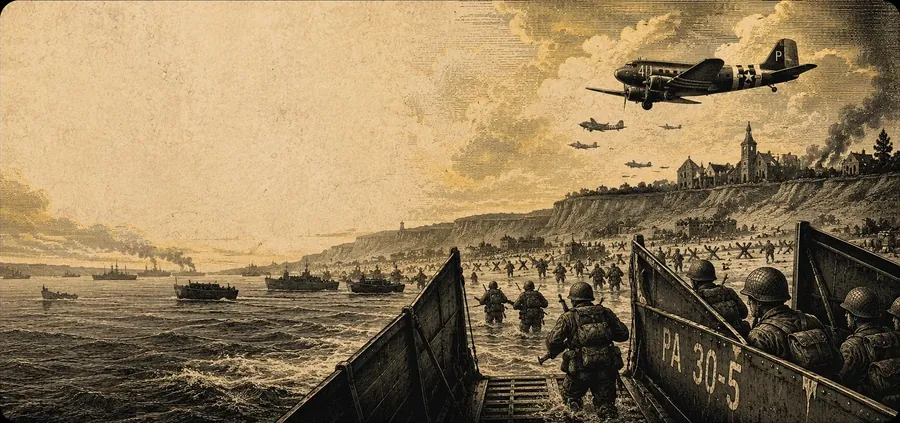
The D-Day Landings
On 6 June 1944, Allied forces landed in Normandy, France, in the largest seaborne invasion in history.
Did you know? The operation depended on a single narrow break in bad weather, identified just days before by a small team of forecasters.
-
10 June 1944 CE
An SS Unit Massacres the Village of Oradour-sur-Glane
On 10 June 1944, an SS division murdered 643 people in the French village of Oradour-sur-Glane, shooting the men and burning the women and children in the church.
Did you know? France left the ruins standing exactly as they were, and they remain a memorial today.
-
13 June 1944 CE
The First Flying Bomb Falls on London
On 13 June 1944, the first German V-1 flying bomb to reach London exploded in Bethnal Green, opening a campaign that killed thousands of civilians.
Did you know? Londoners called them doodlebugs, and learned to fear the moment the engine cut out.
-
15 June 1944 CE
Superfortresses Bomb Japan for the First Time
On 15 June 1944, B-29 Superfortresses flying from bases in China attacked steelworks in southern Japan, the first raid on the home islands since the Doolittle mission.
Did you know? The aircraft was the most expensive weapons project of the war, costing more than the atomic bomb.
-
19 June 1944 CE
Japanese Naval Aviation Is Destroyed in the Philippine Sea
On 19 June 1944, American carriers shot down hundreds of Japanese aircraft in the Philippine Sea in an action so one-sided that pilots called it a turkey shoot.
Did you know? Japan lost three carriers and the trained aircrew it could never replace.
-
22 June 1944 CE
Bagration Destroys Germany's Army Group Centre
On 22 June 1944, three years to the day after the invasion of the Soviet Union, the Red Army opened an offensive in Belarus that annihilated Army Group Centre.
Did you know? It cost Germany more men than Stalingrad, and fifty thousand prisoners were marched through Moscow to prove it.
-
20 July 1944 CE
A Bomb in Hitler's Headquarters Fails to Kill Him
On 20 July 1944, Claus von Stauffenberg left a briefcase bomb in Hitler's East Prussian headquarters, but the blast only wounded him and the coup that followed collapsed within hours.
Did you know? Someone had moved the briefcase behind a heavy table leg, which absorbed much of the explosion.
-
22 July 1944 CE
Allied Nations Sign the Bretton Woods Agreement
On 22 July 1944, delegates from forty-four Allied nations concluded a conference at Bretton Woods, New Hampshire, agreeing to found the International Monetary Fund and World Bank.
Did you know? The system it created tied major currencies to the US dollar, which was itself convertible to gold, shaping global finance for the next three decades.
-
23 July 1944 CE
Soviet Troops Find the Camp at Majdanek Almost Intact
On 23 July 1944, the Red Army reached Majdanek near Lublin and found gas chambers and crematoria the Germans had not managed to destroy.
Did you know? It was the first major camp to be liberated, and journalists were brought in to see it within days.
-
1 August 1944 CE
The Polish Home Army Rises in Warsaw
On 1 August 1944, the Polish Home Army rose against the German occupation of Warsaw and held much of the city for sixty-three days before being crushed.
Did you know? The Red Army halted across the Vistula, and Stalin refused to back the rising, whose defeat removed his political rivals. Around two hundred thousand Poles died before the city surrendered.
-
4 August 1944 CE
Anne Frank and Her Family Are Arrested in Amsterdam
On 4 August 1944, police raided the secret annexe hidden behind an Amsterdam canal house and arrested the eight people living there, including the teenage diarist Anne Frank.
Did you know? Her father was the only one of the eight to survive. Miep Gies and Bep Voskuijl found her diaries and papers on the floor, and Miep later gave them to Otto Frank.
-
15 August 1944 CE
Allied Forces Land on the French Riviera
On 15 August 1944, Allied troops landed on the Riviera coast between Toulon and Cannes and advanced up the Rhone valley far faster than anyone expected.
Did you know? The ports they captured soon handled a third of all Allied supplies reaching France.
-
21 August 1944 CE
The Falaise Pocket Is Closed on the German Army in Normandy
On 21 August 1944, Allied forces sealed the gap near Falaise, trapping the remnants of two German armies and effectively ending the battle for Normandy.
Did you know? Eisenhower said the roads afterwards could be walked for hundreds of yards on nothing but dead flesh.
-
21 August 1944 CE
The Allies Draft the Blueprint for the United Nations
On 21 August 1944, delegates from the United States, Britain, the Soviet Union and China met at Dumbarton Oaks in Washington and drafted the blueprint for what became the United Nations.
Did you know? Almost everything was agreed except who could veto what, which was left for the leaders to settle.
-
25 August 1944 CE
Paris Is Liberated
On 25 August 1944, the German commander of Paris surrendered to French and American forces, and de Gaulle walked down the Champs-Elysees the next day.
Did you know? Hitler had ordered the city destroyed, and the general who refused is remembered for the order he did not obey.
-
8 September 1944 CE
A Rocket Hits London Faster Than the Sound of It
On 8 September 1944, the first German V-2 struck Chiswick in west London, arriving faster than sound with no warning of any kind.
Did you know? It was the first ballistic missile used in war, and the first man-made object to reach space.
-
17 September 1944 CE
Airborne Troops Drop on the Bridges to Arnhem
On 17 September 1944, Allied airborne divisions landed in the Netherlands to seize a corridor of bridges, but the northernmost at Arnhem proved a bridge too far.
Did you know? British paratroops held one end of the Arnhem bridge for four days against armour they had been told was not there.
-
14 October 1944 CE
Rommel Is Forced to Take His Own Life
On 14 October 1944, two generals arrived at Erwin Rommel's home and offered him a choice: poison and a state funeral, or a treason trial for links to the July plot against Hitler.
Did you know? Germany's most famous field marshal was buried with full honours, and the public was told he had died of his wounds.
-
20 October 1944 CE
MacArthur Wades Ashore in the Philippines
On 20 October 1944, American forces landed on Leyte and Douglas MacArthur waded ashore to announce that he had returned, two and a half years after leaving.
Did you know? The landing craft grounded early, which is why the most famous photograph of the war in the Pacific shows a general knee-deep in seawater.
-
23 October 1944 CE
The Largest Naval Battle in History Is Fought off Leyte
On 23 October 1944, the Japanese and American fleets began four days of fighting around Leyte Gulf, the largest naval battle ever fought.
Did you know? Japan sent its remaining carriers north purely as bait, and after it the imperial navy was finished as a fighting force.
-
25 October 1944 CE
Japanese Pilots Begin Deliberate Suicide Attacks
On 25 October 1944, Japanese aircraft made the first organised kamikaze attacks on American ships off the Philippines, sinking an escort carrier.
Did you know? Around four thousand pilots died in such attacks before the war ended.
-
16 December 1944 CE
Germany Attacks Through the Ardennes in Winter
On 16 December 1944, German armies attacked through the snow-covered Ardennes forest, driving a bulge into the American line in the last great German offensive of the war.
Did you know? Asked to surrender at Bastogne, the American commander is said to have replied with a single word: nuts.
-
17 December 1944 CE
SS Troops Shoot American Prisoners at Malmedy
On 17 December 1944, SS troops advancing through the Ardennes machine-gunned around eighty-four captured American soldiers in a field near Malmedy.
Did you know? News of it spread along the front within days and hardened the fighting that followed.
-
29 December 1944 CE
Soviet Armies Encircle Budapest
On 29 December 1944, Soviet forces completed the encirclement of Budapest, beginning a siege that destroyed much of the city over the following seven weeks.
Did you know? The retreating Germans blew up every bridge over the Danube in the capital.
-
12 January 1945 CE
The Red Army Drives From the Vistula to the Oder
On 12 January 1945, Soviet forces attacked out of their bridgeheads on the Vistula and in three weeks reached the Oder, some forty miles from Berlin.
Did you know? It was one of the fastest advances of the war, covering around three hundred miles in under a month.
-
18 January 1945 CE
The SS Marches Auschwitz's Prisoners West Through the Snow
On 18 January 1945, with Soviet troops approaching, the SS forced some sixty thousand prisoners out of Auschwitz on foot in midwinter, shooting those who fell behind.
Did you know? Around fifteen thousand died on the roads, and only the sick left behind in the camp were there to be liberated nine days later.
-
27 January 1945 CE
Soviet Troops Liberate Auschwitz
On 27 January 1945, Soviet soldiers reached the Auschwitz camp complex in occupied Poland and found several thousand prisoners too weak to have been marched away.
Did you know? The date is now marked worldwide as International Holocaust Remembrance Day.
-
30 January 1945 CE
A Torpedoed Liner Takes Thousands of Refugees Down With It
On 30 January 1945, a Soviet submarine sank the German liner Wilhelm Gustloff in the Baltic, killing an estimated nine thousand refugees and military personnel.
Did you know? It is the deadliest sinking of a single ship in history, with roughly six times the death toll of the Titanic.
-
4 February 1945 CE
Roosevelt, Churchill and Stalin Meet at Yalta
On 4 February 1945, the three Allied leaders began a week of talks at a palace on the Black Sea coast with Germany close to defeat.
Did you know? They agreed on occupation zones, the United Nations and free elections in eastern Europe; the elections never happened, and the map they sketched held for forty-four years.
-
13 February 1945 CE
Firestorms Destroy Dresden
On the night of 13 February 1945, British and American bombers set Dresden alight in raids that killed around twenty-five thousand people and gutted the baroque city centre.
Did you know? The destruction of a city famous for porcelain and architecture, so late in the war, has been argued over ever since.
-
19 February 1945 CE
Marines Land on the Black Sand of Iwo Jima
On 19 February 1945, US marines landed on Iwo Jima, an island of volcanic ash defended from a network of tunnels dug deep into the rock.
Did you know? Almost the entire Japanese garrison of over twenty thousand fought to the death.
-
23 February 1945 CE
Marines Raise the Flag on Iwo Jima
On 23 February 1945, American marines raised a flag on the summit of Mount Suribachi, five days into a battle for a volcanic island in the Pacific.
Did you know? It was the second flag of the day, put up because the first was too small to see; the photograph won a Pulitzer, and the fighting went on for another month.
-
3 March 1945 CE
The Battle for Manila Leaves the City in Ruins
On 3 March 1945, fighting for Manila ended after a month of street battles and massacres in which around a hundred thousand Filipino civilians died.
Did you know? Manila is often called the second most devastated Allied capital of the war after Warsaw.
-
7 March 1945 CE
American Troops Find a Rhine Bridge Still Standing at Remagen
On 7 March 1945, American soldiers captured the Ludendorff bridge at Remagen intact and were across the Rhine within hours.
Did you know? The demolition charges had fired and failed, and the bridge collapsed of its own accord ten days later.
-
9 March 1945 CE
Incendiary Bombs Burn Out Central Tokyo
On the night of 9 March 1945, American B-29s dropped incendiaries on Tokyo and burned some sixteen square miles of the city, killing about a hundred thousand people.
Did you know? It killed more people in a single night than either atomic bomb did on the day it fell.
-
23 March 1945 CE
Allied Armies Force the Rhine in Strength
On the night of 23 March 1945, British and American forces crossed the Rhine in a full-scale assault, followed by the largest single-day airborne operation of the war.
Did you know? Churchill went over in a landing craft and then stood on the German bank for photographs.
-
1 April 1945 CE
American Forces Land on Okinawa
On 1 April 1945, American troops landed on Okinawa, beginning almost three months of fighting that killed more than a hundred thousand Japanese soldiers and a similar number of civilians.
Did you know? The cost of taking one island weighed heavily on every later argument about invading Japan itself.
-
7 April 1945 CE
The Battleship Yamato Is Sunk on a One-Way Mission
On 7 April 1945, American aircraft sank the Yamato, the largest battleship ever built, as she steamed towards Okinawa with only enough fuel to get there.
Did you know? She went down with around three thousand of her crew, having barely fired her main guns at an enemy ship in the whole war.
-
11 April 1945 CE
American Troops Reach Buchenwald
On 11 April 1945, American forces entered Buchenwald near Weimar, where prisoners had already seized control of parts of the camp.
Did you know? Eisenhower ordered nearby townspeople brought in to see it, so that no one could later claim it had not happened.
-
12 April 1945 CE
President Franklin D. Roosevelt Dies in Office
On 12 April 1945, US President Franklin D. Roosevelt died suddenly in Georgia, three weeks before Germany surrendered, and Vice-President Harry Truman was sworn in.
Did you know? Truman had been vice-president for less than three months and had never been told about the atomic bomb.
-
15 April 1945 CE
British Troops Enter Bergen-Belsen
On 15 April 1945, British forces reached Bergen-Belsen and found around sixty thousand starving prisoners and thousands of unburied dead.
Did you know? Broadcasts and newsreels from the camp brought the reality of the concentration camps into British homes for the first time.
-
16 April 1945 CE
Soviet Armies Open the Assault on Berlin
On 16 April 1945, more than two million Soviet troops attacked from the Oder towards Berlin in the final offensive of the war in Europe.
Did you know? The attack opened with searchlights aimed at the German positions, which mostly blinded the advancing Soviet infantry instead.
-
25 April 1945 CE
American and Soviet Soldiers Meet at the Elbe
On 25 April 1945, American and Soviet patrols met at Torgau on the river Elbe, cutting what was left of Germany in two.
Did you know? Photographs of the soldiers shaking hands became the image of an alliance that lasted only a few more years.
-
28 April 1945 CE
Partisans Shoot Mussolini as He Flees North
On 28 April 1945, Italian partisans caught Mussolini near Lake Como as he tried to reach Switzerland and shot him, hanging his body in Milan the next day.
Did you know? He had been travelling in a German convoy wearing a Luftwaffe greatcoat.
-
29 April 1945 CE
Dachau, the First Nazi Camp, Is Liberated
On 29 April 1945, American troops entered Dachau near Munich and freed around thirty thousand surviving prisoners in the main camp.
Did you know? Dachau had opened in 1933, weeks after Hitler took power, and every camp built afterwards was modelled on it.
-
30 April 1945 CE
Hitler Takes His Own Life in the Bunker
On 30 April 1945, with Soviet troops a few streets away, Hitler killed himself in the bunker beneath the Reich Chancellery in Berlin.
Did you know? He had married Eva Braun the previous day, and their bodies were burned in the garden above.
-
2 May 1945 CE
Berlin's Garrison Lays Down Its Arms
On 2 May 1945, the German commander in Berlin surrendered the city, ending a battle that had killed tens of thousands on both sides in a fortnight.
Did you know? Soviet soldiers wrote their names on the walls of the Reichstag, and some of that graffiti is still preserved inside the building.
-
5 May 1945 CE
Prague Rises Against the German Occupation
On 5 May 1945, the people of Prague rose against the German garrison and built barricades across the city in the last days of the war in Europe.
Did you know? Some of the help came from an unexpected quarter: a renegade Russian division that had been fighting for Germany changed sides.
-
7 May 1945 CE
Germany Signs Its Unconditional Surrender at Reims
On 7 May 1945, German representatives signed an unconditional surrender at Eisenhower's headquarters in a schoolhouse at Reims, to take effect the following night.
Did you know? The Soviet Union insisted the ceremony be repeated in Berlin, which is why some countries mark the end of the war a day later than others.
-
8 May 1945 CE
Germany Surrenders, Ending World War II in Europe
On 8 May 1945, celebrated as Victory in Europe Day, Germany's unconditional surrender took effect, ending nearly six years of war in Europe.
Did you know? Crowds filled the streets of Allied capitals in spontaneous celebration, even as the war against Japan continued for another three months.
-
26 June 1945 CE
The United Nations Charter Is Signed
On 26 June 1945, representatives of fifty countries signed the United Nations Charter in San Francisco.
Did you know? Poland signed later and became one of the organization's fifty-one original members.
-
16 July 1945 CE
The United States Conducts the First Nuclear Weapons Test
On 16 July 1945, the United States detonated the world's first nuclear weapon in the New Mexico desert, in a test codenamed Trinity.
Did you know? Physicist J. Robert Oppenheimer, who led the laboratory that built the bomb, later said the test brought to mind a line from Hindu scripture: 'Now I am become Death, the destroyer of worlds.'
-
17 July 1945 CE
The Allied Leaders Meet at Potsdam
On 17 July 1945, Truman, Stalin and Churchill met at Potsdam outside Berlin to settle the occupation of Germany and press Japan to surrender.
Did you know? Britain held a general election in the middle of it, and Churchill was replaced at the table by Clement Attlee.
-
26 July 1945 CE
The Allies Demand Japan's Unconditional Surrender
On 26 July 1945, the United States, Britain and China issued the Potsdam Declaration calling on Japan to surrender or face prompt and utter destruction.
Did you know? Japan's government responded with a word that could mean either no comment or contemptuous rejection, and it was read as the second.
-
26 July 1945 CE
British Voters Turn Churchill Out of Office
On 26 July 1945, the results of the British general election gave Labour a landslide, and the man who had led the country through the war left Downing Street.
Did you know? The votes had been cast three weeks earlier and held while ballots came in from servicemen overseas.
-
30 July 1945 CE
A Cruiser Is Lost After Delivering the Atomic Bomb
On 30 July 1945, a Japanese submarine sank the cruiser USS Indianapolis days after she had carried components of the first atomic bomb to Tinian.
Did you know? No one missed her for four days, and only 316 of about 1,195 men aboard were pulled from the water alive.
-
6 August 1945 CE
An Atomic Bomb Destroys Hiroshima
On 6 August 1945, the United States dropped an atomic bomb on the Japanese city of Hiroshima.
Did you know? The explosion and its aftermath killed tens of thousands of civilians and ushered in the nuclear age.
-
8 August 1945 CE
The Soviet Union Attacks Japan in Manchuria
On 8 August 1945, the Soviet Union declared war on Japan and launched a vast offensive into Manchuria that destroyed the Kwantung Army within days.
Did you know? Japan had been hoping Moscow would broker a negotiated peace, and that hope died with the declaration.
-
9 August 1945 CE
A Second Atomic Bomb Is Dropped on Nagasaki
On 9 August 1945, an American aircraft dropped a plutonium bomb on Nagasaki, killing tens of thousands of people instantly.
Did you know? Nagasaki was not the intended target that morning; cloud over Kokura sent the aircraft to its secondary objective.
-
15 August 1945 CE
Japan's Emperor Announces the Surrender by Radio
On 15 August 1945, Hirohito broadcast to his people that Japan would accept the Allied terms, telling them the war had not gone in Japan's favour.
Did you know? It was the first time most Japanese had ever heard the emperor's voice, and officers had tried to seize the recording the night before.
-
2 September 1945 CE
Japan Formally Surrenders, Ending World War II
On 2 September 1945, Japanese officials signed the instrument of surrender aboard the battleship USS Missouri in Tokyo Bay, formally ending the Second World War.
Did you know? The ceremony lasted about twenty minutes and closed a war that had run for six years across most of the planet.
-
20 November 1945 CE
The Nuremberg Trials Begin
On 20 November 1945, an international military tribunal opened proceedings in Nuremberg, Germany, to try senior Nazi leaders for war crimes and crimes against humanity.
Did you know? It was the first time an international court had put an entire regime's leadership on trial, establishing legal precedents still cited in war crimes prosecutions today.
The past already happened.
See if you can put it in order.
Download on theApp Store